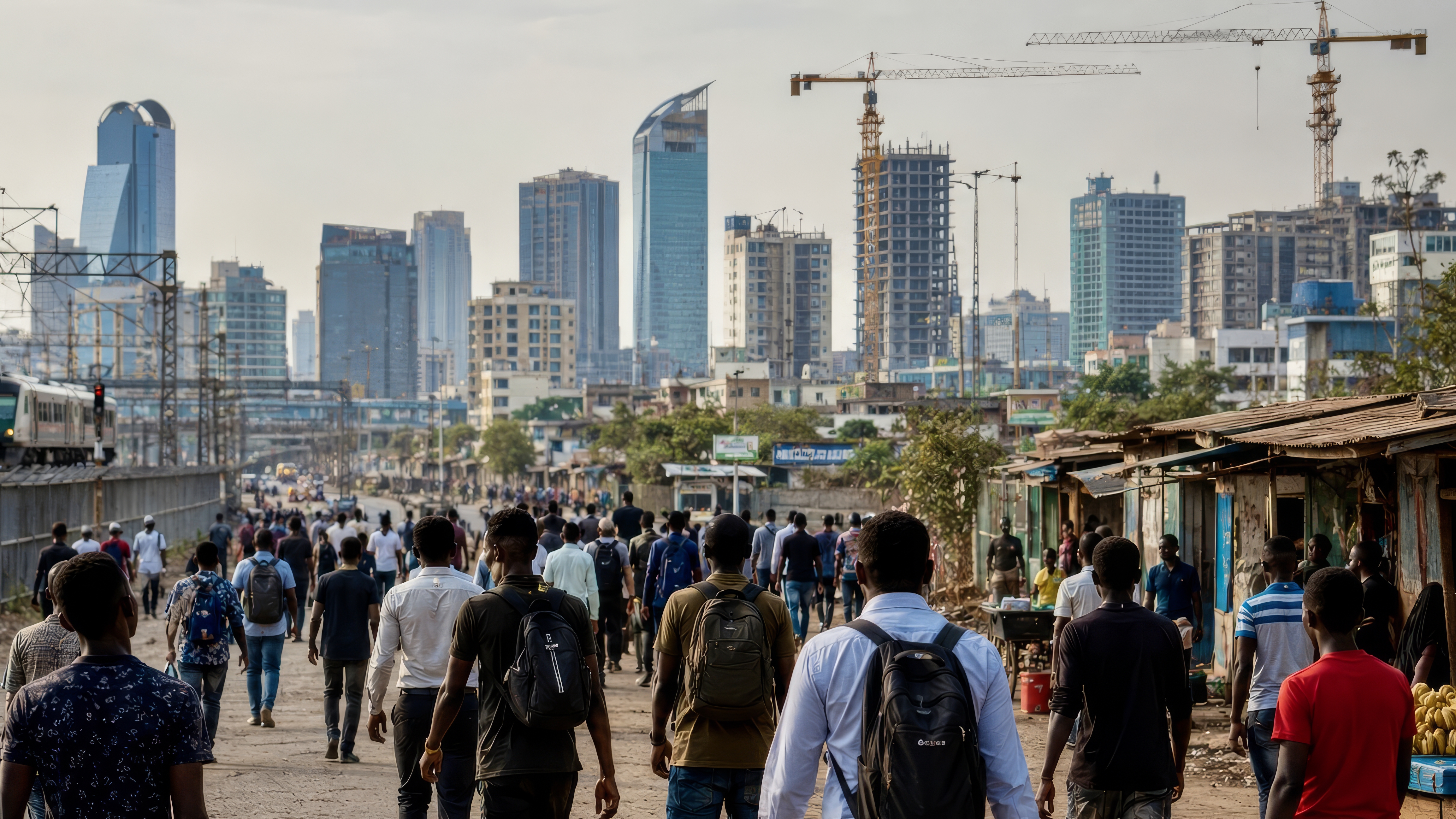
Around 1.2 billion young people in emerging market and developing economies are expected to reach working age over the decade to 2035, creating what a new World Bank advance report describes as a historic global jobs challenge.
The report estimates that this will likely be the largest youth cohort the world will ever see.
The pressure is especially acute because job creation is not expected to keep pace with demographic change in many countries.
Under one illustrative extrapolation cited by the World Bank, just over 400 million of those 1.2 billion young people would be employed in 2035, while about 300 million would not be in employment, education or training.
The report says the challenge is concentrated in emerging market and developing economies, where jobs remain central to income growth, poverty reduction and social stability.
It frames the coming decade not only as a labor-market test, but as one of the defining development issues for governments and international institutions.
Africa Faces the Largest Regional Test
Sub-Saharan Africa is at the center of the shift.
The World Bank projects that more than 330 million young people will live in Sub-Saharan Africa in 2035, almost two-and-a-half times as many as in 2000.
Using another measure, the report estimates that 330 million young people will enter working age in Sub-Saharan Africa between 2025 and 2035.
South Asia is also expected to face a large jobs challenge, with about 280 million young people entering working age over the same period.
East Asia and Pacific has a similarly large inflow under the youth measure, but other demographic measures show a different picture because more older workers are also aging out of the labor force.
The report says no single estimate captures the whole problem, but the broad conclusion is consistent: the jobs challenge is largest in Sub-Saharan Africa, South Asia and the Middle East and North Africa.
Slower Growth Makes the Challenge Harder
The demographic surge is arriving as the global economy is less supportive than it was during earlier development success stories.
The report says global growth has slowed, investment has weakened, trade growth is below historical averages and uncertainty remains elevated.
That matters because faster output growth and stronger investment have historically been linked with faster employment growth.
The World Bank also warns that many of the countries facing the largest jobs challenge have weaker starting positions than other regions had during their own peak youth-cohort periods.
Those constraints include lower incomes, weaker institutions, high debt burdens and limited fiscal space.
More than one-fifth of the 1.2 billion young people expected to reach working age over the next decade live in places currently classified as fragile and conflict-affected.
Policy Will Decide the Outcome
The report says a jobs crisis is not inevitable.
It argues that governments should focus on three broad pillars: foundational infrastructure, a business-enabling environment and mobilizing private capital.
Foundational infrastructure includes physical, digital, human and natural capital.
A better business environment, the report says, depends on macroeconomic stability, effective institutions and regulations that allow firms to grow.
Private capital is described as essential because the scale of job creation required cannot be met by public spending alone.
The World Bank also identifies five sectors with potential to create local and resilient jobs at scale: infrastructure, agribusiness and farming, tourism, health, and value-added manufacturing.
The report cautions that there is no universal formula.
Policies will need to vary by country, especially because the jobs challenge differs sharply between large economies, low-income countries, fragile states and countries with fast-growing youth populations.
But the central message is clear: the next decade will test whether developing economies can convert a historic youth wave into employment, income growth and broader development gains.